The Free AI Automation Assessment: A Lead Magnet That Sells Itself
The Problem
Most business owners don't know what they don't know.
Automation is invisible until someone shows you exactly where it fits. Most owners have never been shown that, so they assume it's not relevant to them.
01.
No frame of reference
A med spa owner doesn't think in terms of "agentic workflows." They think in terms of missed calls and no-shows. If you don't speak their language first, they tune out.
02.
Trust has to be earned before the pitch
Nobody books a 30-minute call with a stranger based on a claim. They book it after seeing something specific and useful for free.
03.
Most lead magnets are generic
A PDF titled "10 Ways AI Can Help Your Business" gets skimmed and forgotten. It's not about their business, it's a template wearing a business card.
04.
Long forms kill momentum
Every extra question between curiosity and value is a chance for someone to close the tab. The more you ask before you give something back, the fewer people get to the end.
The result: people who'd genuinely benefit from automation never find out, because nothing showed them first.
How It Works
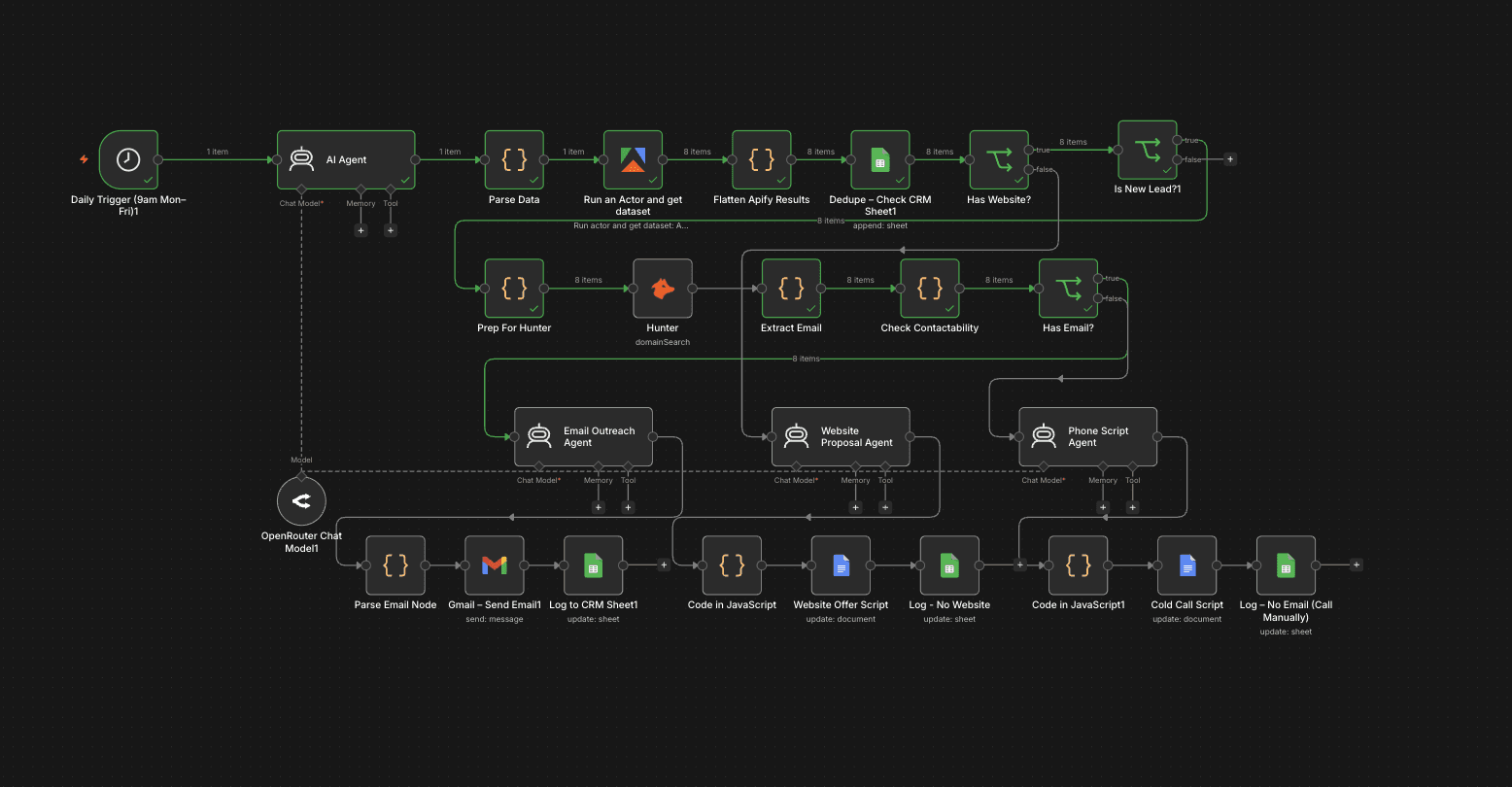
Type your business. Get 3 real ideas. Check your inbox.
01
Input
02
Generate
AI Agent
AI Agent, industry-specific An AI agent reads the business type and writes exactly 3 automation ideas built around what that kind of business actually loses time and money on — a name, what it does, and roughly how many hours a week it saves.
03
Deliver
Hook
Deliver Inbox, not a popup The result doesn't render on the page. It's sent straight to their inbox with a short personal note and a direct invite to book a 30-minute call. The widget itself just confirms it's on the way.
04
Convert
Field prep
The hook is already set By the time someone reads the email, they've already seen 3 specific ideas for their own business. The call isn't a cold pitch anymore — it's a follow-up on something they already want.
AI Agent
Why This Works
Why Minimalism Won
I tested the version with more questions first.
The first version of this asked for name, email, team size, biggest time drain, and primary goal… 5 fields split across two screens, before the AI even ran. It felt more "qualified." It produced worse results.
More fields = more friction, less reach.
Every additional question is a chance to lose someone who was only mildly curious. Mild curiosity is exactly the audience a lead magnet needs to capture. They're not ready to commit, but they are willing to type one sentence about their job.
The AI doesn't need 5 answers to be specific.
One sentence "real estate agency" is enough for the AI agent to write 3 ideas that feel personal. Team size and stated goals barely changed the output. The industry alone carries almost all the signal.
Less data up front, more data overall.
A 5-field form filters out anyone who isn't already half-sold. A 1-field form catches the curious and the committed alike and the email itself becomes the qualifying step, not the form.
The email IS the second touchpoint.
Instead of asking more questions before delivering value, the value gets delivered first, by email, with the call CTA built in. The form's only job is to capture enough to make that email land somewhere real.
Minimal isn't the lazy version. It's the version that gets more people to the part that actually moves the needle.
Tech Stack


n8n
Orchestrates the workflow end-to-end

OpenRouter
Generates the 3 industry-specific automation ideas

Gmail + Google Workspace
Sends the formatted result with the Calendly CTA